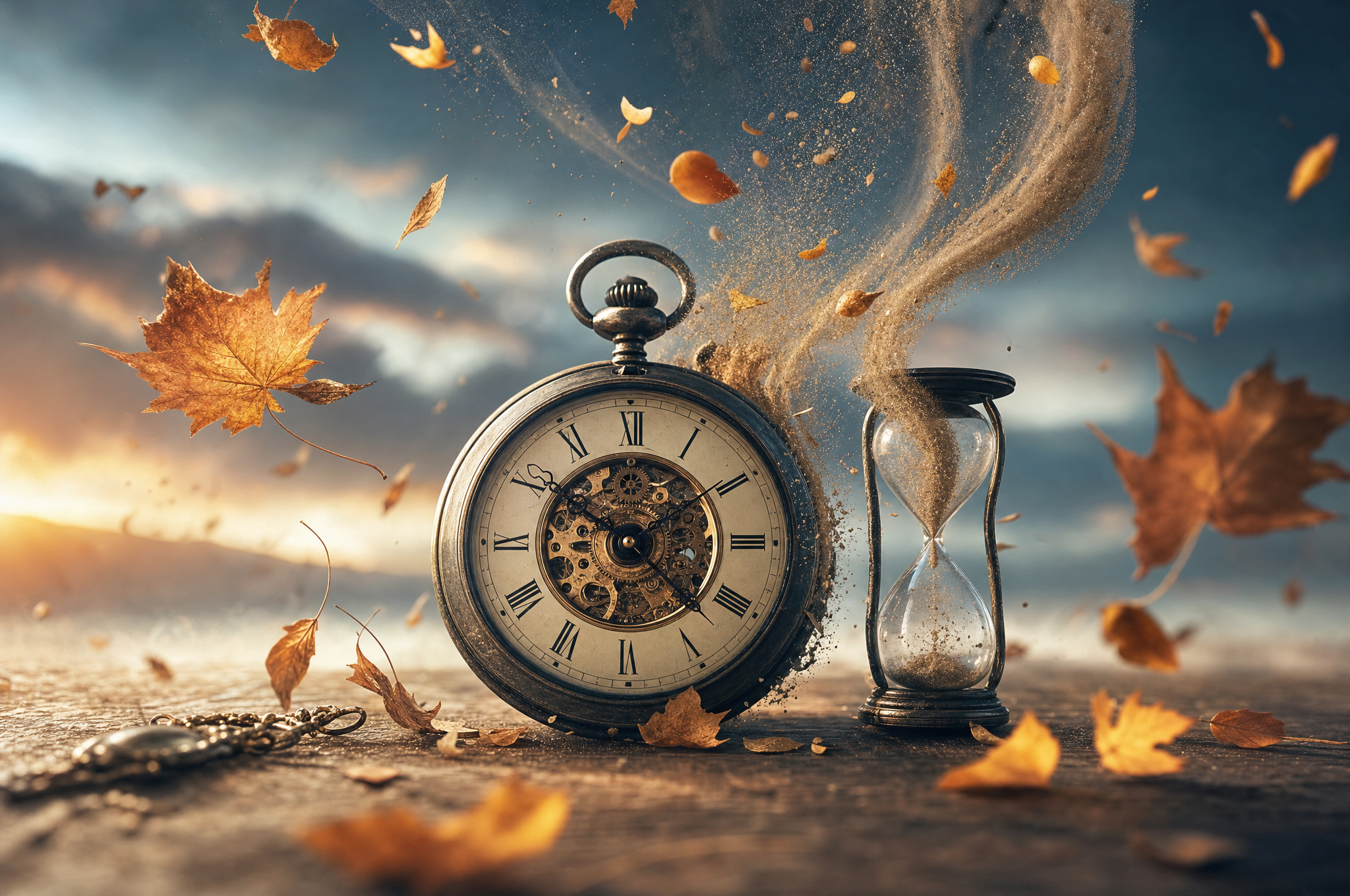
Think back to the summer when you were ten years old. It probably felt endless — each day stretched luxuriously, packed with new experiences. Now think about last year. If you're like most adults, it probably felt like it passed in a blur. The years seem to accelerate, and the months blur together like scenery from a moving train. This isn't your imagination failing you. It's one of the most well-documented phenomena in the psychology of time perception, and scientists have spent decades trying to explain why our subjective clock seems to speed up as we age.
The Proportionality Theory: A Matter of Fractions
The oldest and simplest explanation dates back to 1897, when philosopher Paul Janet — brother of the pioneering psychologist Pierre Janet — proposed what we now call the proportionality theory. The idea is deceptively straightforward: our perception of a unit of time is proportional to the total amount of time we've been alive.
When you're ten years old, one year represents 10% of your entire existence. It feels enormous. When you're fifty, that same year is just 2% of your life — a much smaller slice, and your brain treats it accordingly. Under this theory, the perceived duration of any time period shrinks as you accumulate more of them, simply because each new unit is a smaller fraction of the whole.
It's an elegant explanation, and it captures something true about how we instinctively think about time. But it's not the whole story. If proportionality alone explained the effect, time should accelerate smoothly and predictably throughout life. Instead, research shows the acceleration is uneven — it's most pronounced between childhood and early adulthood, then levels off somewhat. Something else is going on.
The Novelty Hypothesis: Your Brain Loves New Things
Enter the novelty hypothesis, which most neuroscientists today consider the more compelling explanation. The theory, developed in the 1970s and refined since, hinges on a simple observation: we remember novel experiences better than routine ones.
Consider a child's week versus an adult's week. A child might experience their first day of school, a new friend, a scraped knee, and a thunderstorm all in a few days. Each event is fresh and vivid, and the brain encodes them richly. When the child looks back on that week, it feels dense and full — and therefore, long.
An adult's week, by contrast, might consist of commuting to the same office, doing similar tasks, eating familiar meals, and watching familiar shows. The brain has seen all this before. It doesn't bother laying down rich new memories for routine events — that would be a waste of neural resources. So when the adult looks back on their week, there's very little to recall. The week feels like it passed in a blink.
When you're a child, everything is new. Your brain is encoding constantly, and each memory makes time feel fuller. As you age, routine takes over, memory density drops, and time appears to compress.— Dr. David Eagleman, neuroscientist and time-perception researcher
The Brain's Internal Clock
Neuroscience offers a third layer of explanation. Deep inside your brain, in a region called the striatum, there's a network of neurons that appears to function as an internal clock. This network releases the neurotransmitter dopamine in rhythmic pulses, and your brain uses the frequency of these pulses to estimate how much time has passed.
Here's the catch: dopamine levels naturally change as we age. In childhood, the dopamine system is highly active, and the internal clock ticks rapidly — making external time feel slower by comparison. As dopamine production gradually declines with age, the internal clock slows, and external time starts to feel like it's passing more quickly. It's the same reason time seems to crawl when you're bored (low dopamine) and fly when you're having fun (high dopamine).
Why the "First Time" Matters
Have you ever noticed that the drive to a new place feels much longer than the drive back? This is the novelty effect in real time. On the way there, your brain is processing unfamiliar scenery, making predictions, and laying down new memories. Time expands. On the way back, the route is known, your brain goes on autopilot, and time contracts.
This has a profound implication for the speeding-up of time as we age: it's not aging itself that makes time fly — it's the accumulation of routine. A forty-year-old who travels constantly, learns new skills, and seeks out novel experiences may find time moving at a more leisurely pace than a twenty-year-old stuck in a monotonous job.
Key Takeaway
Time feels faster as we age primarily because we experience fewer novel events. The brain encodes routine experiences sparsely, so retrospective time compresses. To slow time down, seek new experiences — they give your brain more to remember.
Can You Slow Time Down?
If the novelty hypothesis is correct — and the evidence strongly suggests it is — then there's an actionable implication hiding in this research. You can partially reverse the acceleration of time by deliberately introducing novelty into your life.
This doesn't mean you need to quit your job and move to another country (though that would certainly work). Smaller interventions help too:
- Take different routes to familiar places, exposing your brain to new visual input.
- Learn a new skill — a language, an instrument, a sport. Learning forces the brain to form new neural pathways and encode new memories.
- Travel, even locally. A weekend in an unfamiliar town gives your brain a week's worth of new memories.
- Break routines deliberately: cook a new recipe, read outside your usual genre, have a conversation with someone new.
- Practice mindfulness. Paying close attention to the present moment forces richer encoding, even during ordinary activities.
The Paradox of Time
There's a wonderful paradox at the heart of all this. The same mechanism that makes time fly as we age — the brain's efficiency at dismissing the familiar — is also what makes life feel rich when we're young. Your brain can't have it both ways: either it processes everything as new (and time feels slow but life feels full), or it efficiently filters the routine (and time flies but you get more done).
The best we can do is be intentional about it. Time will always speed up somewhat as we accumulate years — that's the proportionality effect, and there's no escaping arithmetic. But we have more control than we think over how fast the dial spins. Every novel experience is a small rebellion against the compression of time.
So the next time a week vanishes and you can't account for it, consider: what was new? What gave your brain something worth remembering? The answer might explain why time felt the way it did — and what you might do differently next week to slow it back down.
Curious about how your brain processes these experiences? Explore our related article on how memory works — it turns out the encoding process that makes time feel slow is the same one that determines what you'll remember tomorrow.