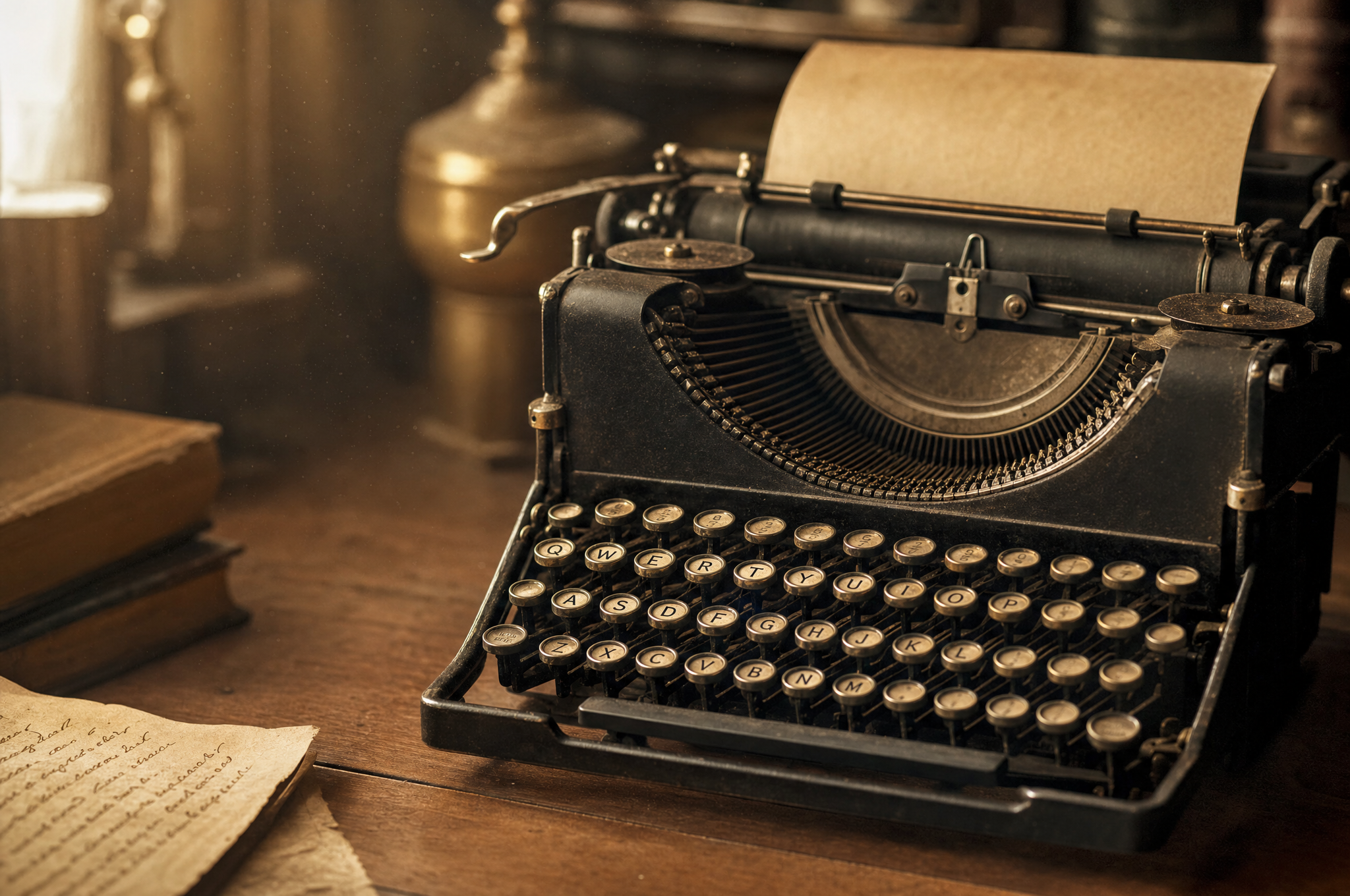
Look down at your keyboard. Or your phone screen. Chances are the first six letters on the top row spell Q-W-E-R-T-Y. You've probably never thought about why they're arranged that way — it's just how keyboards are. But this layout was designed in the 1870s to solve a problem that hasn't existed for a hundred years. The story of QWERTY is a story about how a single decision, made under very specific constraints, can lock in an entire civilization — long after those constraints vanish.
The Problem: Mechanical Typewriter Jams
In the early 1870s, a newspaper editor and inventor named Christopher Latham Sholes was working in Milwaukee, Wisconsin, on a machine that would change the world: the typewriter. Early typewriters used a system of metal arms called "typebars," each with a character at the end. When you pressed a key, the corresponding typebar swung up and struck an inked ribbon against the paper, leaving a mark.
But there was a problem. If you typed too fast, and especially if you pressed two adjacent keys in quick succession, the two typebars would collide and jam. The operator would have to stop, reach into the machine, and manually untangle the arms. This slowed typing considerably and was frustrating enough to limit the typewriter's commercial appeal.
Sholes's early prototypes used an alphabetical layout — A, B, C, D, and so on across the keyboard. This was intuitive but disastrous for jams, because many common letter pairs in English (like "TH" and "ER") sat next to each other alphabetically and were typed in rapid succession.
The Solution: Spreading Common Pairs Apart
Sholes, working with mathematician and educator Amos Densmore (who analyzed letter-pair frequencies in English), redesigned the layout to physically separate common letter pairs. By placing frequently combined letters like "T" and "H," or "E" and "R," on opposite sides of the keyboard, the typebars would approach the ribbon from different angles and were far less likely to collide.
The result was the QWERTY layout, patented in 1878. Note what QWERTY was and wasn't: it was not designed to slow typists down (a common myth). It was designed to prevent jams by ensuring that common letter sequences came from typebars that wouldn't physically interfere with each other. Once jams were reduced, typists could actually type faster — the opposite of the "slow people down" myth.
The QWERTY layout was not designed to slow typists down. It was designed to place common letter pairs on non-adjacent typebars, reducing the jams that were slowing typists down.— Correcting a persistent myth about keyboard history
There's also a nice detail: the top row was arranged so that the letters "TYPEWRITER" could be typed using only the top row — a feature Sholes reportedly included to make it easy for salesmen to demonstrate the machine. (Look: T-Y-P-E-W-R-I-T-E-R — all on the top row.) Whether this was intentional or coincidental is still debated, but it's a charming bit of history.
The Remington Deal and Mass Adoption
Sholes licensed his design to E. Remington and Sons, a firearms and sewing machine manufacturer that was looking to diversify after the Civil War. Remington produced the "Sholes and Glidden Type Writer" in 1874, and later the vastly improved Remington No. 2 in 1878, which featured both upper and lowercase letters via a shift key.
Remington was the first to mass-produce typewriters, and they chose QWERTY. This matters enormously, because once typists learned QWERTY, they didn't want to relearn a different layout. Typing schools taught QWERTY. Businesses bought QWERTY typewriters because that's what their typists knew. By the time competing typewriter manufacturers entered the market, QWERTY had a dominant installed base.
The Touch Typing Revolution
In the late 1880s, a typing instructor named Frank McGurrin made a fateful decision. He taught himself to type without looking at the keys — "touch typing" — using the QWERTY layout, with a specific finger assignment (the "home row" method still taught today). In 1888, McGurrin entered a widely publicized typing contest against a rival using a different keyboard layout. He won decisively, partly because touch typing is faster than hunt-and-peck, and partly because he'd practiced obsessively.
This victory cemented two things simultaneously: the superiority of touch typing, and the dominance of QWERTY. Touch typing instruction manuals were written for QWERTY. Typing schools standardized on it. By 1900, QWERTY was effectively locked in as the American standard.
Key Takeaway
QWERTY was designed by Christopher Sholes in the 1870s to prevent mechanical typewriter jams by separating common letter pairs. It wasn't designed to slow typists down. Once Remington mass-produced it and typing schools standardized on it, the layout became locked in through what economists call "path dependence."
The Dvorak Challenge
In the 1930s, an educational psychologist named August Dvorak (a cousin of the composer Antonín Dvořák) designed an alternative layout, now called Dvorak Simplified Keyboard (DSK). Dvorak placed all the vowels on the home row under the left hand, and the most common consonants on the home row under the right hand. This meant a typist using Dvorak could type thousands of common English words without leaving the home row.
Dvorak claimed his layout was faster, more accurate, and less fatiguing. He conducted studies that appeared to support this. But the studies were later criticized for methodological flaws — including the fact that Dvorak had a financial interest in his layout's adoption. Later, more rigorous studies found little to no speed advantage for Dvorak over QWERTY among typists of equivalent training.
Even if Dvorak were marginally better, it faced an insurmountable problem: switching costs. Millions of typists knew QWERTY. Millions of typewriters had QWERTY keys. Retraining everyone and replacing all the hardware would cost a fortune, for a benefit that was at best modest. The market stayed with QWERTY.
Why We Still Use It: Path Dependence
Economists have a name for this phenomenon: path dependence. It describes situations where an initial decision, often made for reasons that no longer apply, becomes locked in because switching to a different option is too costly — even if the alternative is objectively better.
QWERTY is the textbook example. The problem it was designed to solve — typebar jams — disappeared with the invention of electric typewriters in the 1920s and was completely irrelevant by the time computer keyboards arrived in the 1970s. There are no typebars on your phone. There are no typebars on your laptop. The constraint that created QWERTY has been gone for a century. And yet here we are, typing QWERTY on glass screens.
Will It Ever Change?
Probably not. Several factors keep QWERTY entrenched:
- Muscle memory: Once you've learned QWERTY, switching to a new layout means weeks or months of slow, frustrating retraining. Most people never bother.
- Universal compatibility: Every keyboard in every office, café, and airport uses QWERTY. Knowing QWERTY means you can type anywhere.
- Software defaults: Every operating system ships with QWERTY as the default. Most users never change it.
- Network effects: When everyone uses the same layout, there's no incentive for any individual to switch.
Meanwhile, modern alternatives like swipe-typing, predictive text, and voice-to-text are changing how we input text — but they're layered on top of QWERTY, not replacing it. The layout persists underneath, a fossil of 1870s mechanical engineering living inside your 2026 touchscreen.
So the next time you type "QWERTY" — on a device with no moving parts, no inked ribbon, and no typebars to jam — spare a thought for Christopher Sholes and his jamming problem. He couldn't have known that his solution to a mechanical annoyance would become one of the most widely shared standards in human history. But that's how path dependence works: the decisions that seem smallest at the time are sometimes the ones that last the longest.
Curious about other technologies that outlived their original purpose? Read about how quartz watches keep time — a technology that replaced centuries of mechanical clockmaking with a vibrating crystal.